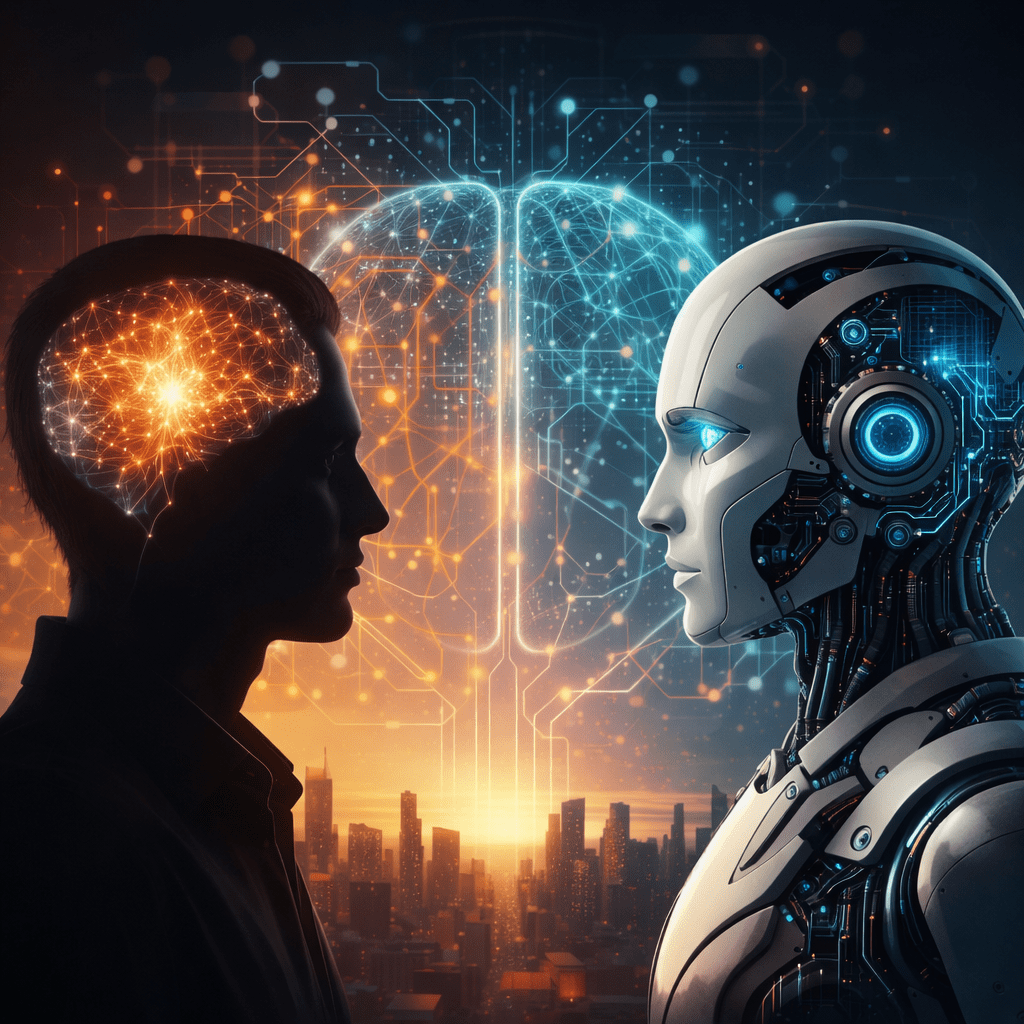
At a recent talk by Benedikt Lehnert, a question lingered with me long after the session ended:
What comes after efficiency?
For more than a century, we have optimized work. Frederick Taylor split tasks into measurable pieces. Organizations refined systems to maximize output. We built entire management philosophies around precision and control.
Efficiency became synonymous with progress.
And now, machines do efficiency better than we ever could.
They draft, summarize, classify, predict.
They generate the “right” answer in seconds.
But as Lehnert suggested, the efficient answer is often the average answer.
If machines can optimize the known, what is left for us?
Ingenuity.
Not creativity in the abstract sense. Not brainstorming without direction. But ingenuity applied imagination under constraint.
Creativity dreams of flying.
Ingenuity builds the plane.
In a world increasingly shaped by artificial intelligence, the differentiator is no longer raw intelligence. Intelligence is being commoditized. What remains scarce is the ability to frame the right problem, connect disparate ideas, and move beyond automation into true invention.
Gallup reports that only a small fraction of the global workforce is fully engaged. Perhaps this is not a coincidence. When systems are designed primarily for efficiency and approval they suppress the very conditions that enable ingenuity: safety, space, critique, and even play.
We have trained people to follow process.
We now need to train people to think divergently.
Research on cognitive leaps suggests that exposure to adjacent fields fuels breakthrough thinking. Brain-to-brain coupling shows that shared mental states can generate entirely new ideas. Real progress has historically come not from doing old things faster, but from doing new things altogether.
The challenge ahead is not to outcompete machines at thinking.
It is to cultivate the distinctly human capacities that machines cannot replicate yet.
Curiosity.
Judgment.
Courage.
Fear shrinks creativity. Courage expands it. Creative self-efficacy, the belief that one can generate and act on novel ideas, becomes foundational in an AI-driven world.
If machines think, humans must design.
If machines optimize, humans must imagine.
If machines automate, humans must question what should be built in the first place.
The future will not be won by those who master efficiency alone. It will belong to those who cultivate ingenuity.
With appreciation to Benedikt Lehnert for the provocation that sparked this reflection.
 Exploring AI & Leadership, one idea at a time
Leave a comment